
In the professional agricultural sector, nutrient management is the cornerstone of success. Generic fertilizers often provide balanced nutrition, but specific developmental phases demand specialized ratios. NPK 13-40-13 is a specialized water-soluble fertilizer designed for two critical moments: early seedling establishment and the pre-flowering stage.
Its distinct 13-40-13 ratio (13% Nitrogen, 40% Phosphorus, 13% Potassium) provides a massive, targeted shot of energy exactly where the plant needs it most.
1. Deconstructing the Formula: Why 13-40-13?
To understand its value, we must break down the macronutrients and why this high-phosphorus ratio works:
13% Nitrogen (N): The primary driver of vegetative growth. This amount is sufficient to keep the green canopy healthy and photosynthetic without triggering excessive leafy growth at the expense of root development or flower production. It is a balanced blend of ammoniacal and nitrate nitrogen for both instant and sustained uptake.
40% Phosphorus ($P_2O_5$): This is the core of 13-40-13. Phosphorus is essential for energy transfer (ATP), DNA synthesis, and cellular division. In large ratios, it stimulates explosive root elongation and is the key regulator for floral induction and robust flowering.
13% Potassium ($K_2O$): Often called the "quality nutrient," potassium manages water uptake, supports enzyme activity, and strengthens plant structure. The equal amount of N and K (13%) ensures the plant is structurally sound enough to support the root mass and floral heavy lifting driven by the high P.
2. Key Operational Uses in Agriculture
Professional growers employ NPK 13-40-13 during specific windows when the demand for ATP (energy) and root stimulation peaks.
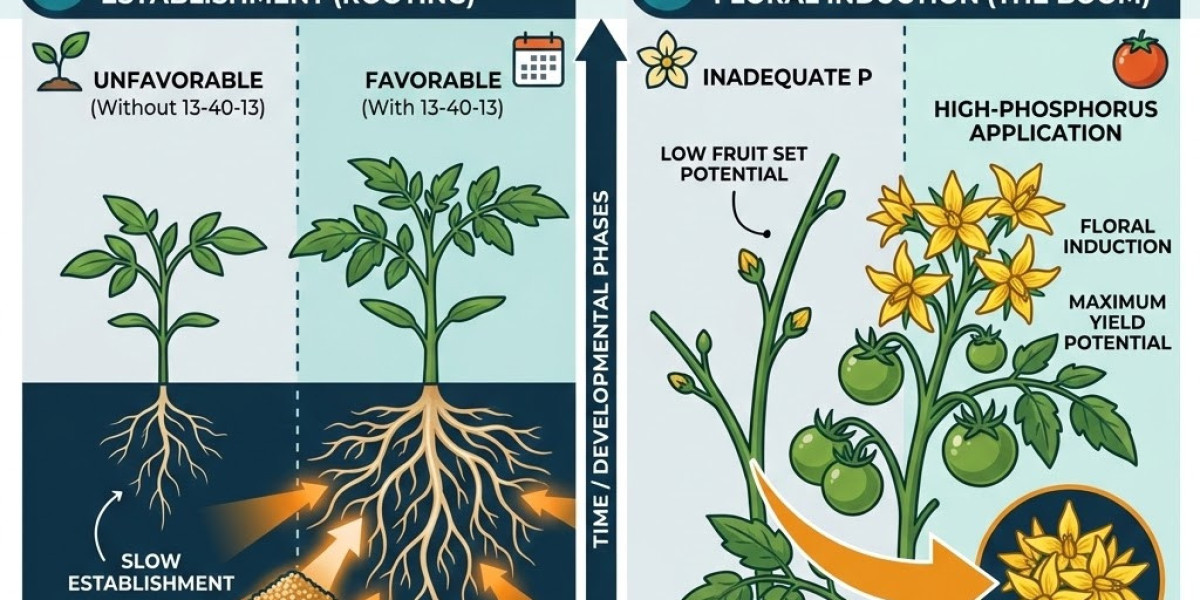
Phase A: Sowing & Transplant Establishment (Rooting)
This is the single most common use for high-phosphorus formulas. 13-40-13 should be applied during the "starter" phase.
Action: When a seedling is transplanted or germinates, its root system is fragile. Application stimulates intense cell division in the meristematic tissue of the roots, forcing the root hairs to stretch and branch out.
Outcome: Rapid establishment, significantly reduced transplant shock, and a "head start" that dictates the crop's final yield potential.
Phase B: Flower Induction (The Pre-Bloom Boom)
Transitioning from vegetative growth to reproductive growth (flowering) is energy-intensive.
Action: Applying 13-40-13 right before the plants form buds signals the plant to shift its energy allocation from making leaves to developing dense, robust reproductive structures.
Outcome: Exploded flower counts, uniform bloom development, and a higher potential for heavy, uniform fruit set.
3. Recommended Application Methods
Because NPK 13-40-13 is usually a highly soluble, professional-grade powder, it is ideal for precise application systems.
Fertigation (Drip/Sprinkler Systems)
This is the superior method. Solubilizing the nutrient and delivering it directly to the root zone via irrigation guarantees maximum absorption.
Focus: Perfect for starter fertilization in vegetable crops (tomatoes, peppers, cucumbers) or targeted flower support in orchards (mango, citrus).
Foliar Spray
The leaves absorb phosphorus quickly. Foliar application is ideal for quickly correcting a P-deficiency or providing an instant boost right before a critical flowering event.
Caution: Always apply foliar sprays during the cooler parts of the day (early morning or evening) to avoid leaf burn, and ensure the product is fully dissolved.
Hydroponics
Because it lacks urea and contains a complete spectrum of micronutrients, 13-40-13 is a powerful "Bloom A" component in recirculating hydroponic systems, where precise control over phosphorus is crucial.
4. Profitability: Measuring the ROI of Specialized P
Is investing in a niche formula like 13-40-13 worth the cost compared to a standard 19-19-19? For high-value crops, the answer is usually yes.
| Measurement | Crop Outcome with 13-40-13 | Economic Value |
| Establishment Speed | Crops reach full maturity 5–10 days faster. | Enables faster crop rotation, increasing annual yield. |
| Resilience | Enhanced root mass allows the plant to access deep water. | Reduces irrigation needs during drought stress. |
| Floral Uniformity | More flowers open simultaneously. | Standardizes harvest, reducing labor costs and crop waste. |
| Final Weight | Phosphorus dictates seed and fruit density. | Direct increase in total marketable yield weight. |
Conclusion
NPK 13-40-13 is not a "jack-of-all-trades" fertilizer. It is a precise tool designed to do two things very well: build a powerful root system and stimulate massive flowering.
For the modern agronomist or farm manager, using 13-40-13 during the starter and pre-bloom phase is a strategic decision. It reduces risk during early growth and maximizes revenue potential by ensuring the crop enters the reproductive phase with an excess of the energy needed for a heavy harvest.